
Accelerating Growth in India’s Auto Sector with Supply Chain Finance
India’s automotive sector is a manufacturing hub, driving 7.1% of the national GDP which contributes nearly 17% to the manufacturing GDP. The sector supports more than 60 million people with a turnover of approximately 200 billion dollars. Globally, India ranks as the fourth-largest vehicle producer, with ambitions to become the nation’s third-largest vehicle manufacturer by 2026. This surge is fueled by expansive manufacturing networks, a growing focus on exports, and a shift towards electric vehicles (EVs) with the rising demand. Notably, the Government of India’s recent approval of 17 major Production Linked Incentive (PLI) schemes is propelling further capacity expansion and innovation, underscoring the importance in the nation’s economic development.
The sector is accelerating growth with its vision of becoming the nation’s third-largest vehicle manufacturer by 2026. However, the main challenge is the timely availability of working capital across the automotive landscape. The businesses that produce auto components and ancillaries face consistent challenges that restrict their expansion. India’s automotive supply chain relies heavily on MSME suppliers that manufacture specialised parts essential to production continuity, but these smaller suppliers face significant cash flow gaps due to delayed payments from large manufacturers and extended credit terms. These gaps strain working capital, limit production upgrades, and increase the risk of supply chain disruptions.
To overcome these financial constraints, the Reserve Bank of India introduced the Trade Receivables Discounting System (TReDS) in 2014, which has emerged as a foundational infrastructure to streamline supply chain efficiency.
What is Supply Chain Financing?
Supply Chain Finance (SCF) is a financial solution that streamlines working capital and cash flow in supply chains by enabling suppliers to receive early payment for their invoices. SCF leverages the creditworthiness of the buyer, such as larger original equipment manufacturers (OEMs), rather than the supplier’s, allowing micro, small, and medium enterprises (MSMEs) to access funds at competitive rates without taking on debt or requiring heavy collateral. This system transforms unpaid receivables into liquidity that suppliers can reinvest to sustain and expand their operations.
Need for TReDS in the Auto Sector
India’s automotive supply chain depends on the MSME suppliers for manufacturing specialised parts and components essential for production continuity. However, delayed payments from large manufacturers such as Original Equipment Manufacturers (OEMs) and extended credit terms often lead to significant cash flow gaps for these smaller suppliers. These gaps strain working capital, limit production upgrades, and increase the risk of supply chain disruptions.
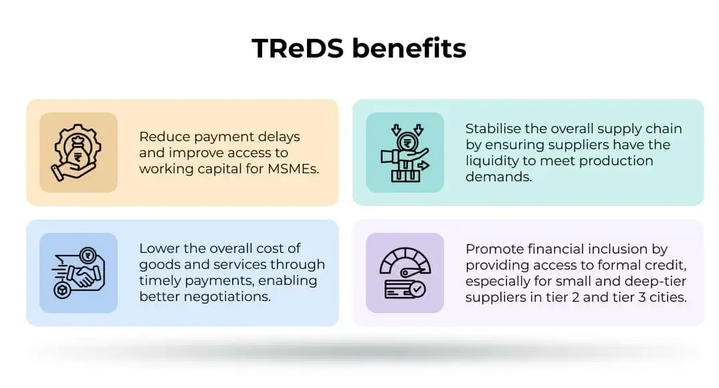
The Trade Receivables Discounting System (TReDS) is a regulated digital marketplace where MSMEs can auction their trade receivables to multiple financiers, gaining access to instant capital at reduced financing costs. For the auto sector, TReDS delivers the following key benefits:
Integrating TReDS Platforms
By implementing TReDS platforms, MSMEs can improve workflow efficiency and accelerate access to financing. This integration addresses working capital challenges and enhances overall ecosystem efficiency, positioning the automotive sector to contribute meaningfully to India’s economic growth and future prospects.
With increasing adoption of TReDS and innovative supply chain finance solutions, the Indian automotive sector is building a resilient, efficient ecosystem. By overcoming these sectoral challenges, the industry is creating a future impact, particularly as it navigates the growing focus on exports and electric vehicles (EVs), complementing government initiatives such as the major PLI schemes to drive national economic development.
Charting the Future of the Automotive Sector
Embracing innovative TReDS mechanisms, such as DTX by KredX, is central to overcoming the current sectoral challenges. As India pursues a future ambition of being the third-largest vehicle manufacturer in 2026 by exports and electric vehicle innovation, TReDS platforms provide the financial support necessary for MSMEs to contribute effectively. Coupled with the government initiatives, these efforts are creating a sustainable, future-ready automotive ecosystem that will showcase India’s position as a global manufacturing powerhouse.