
Growth Readiness for 2026: Financial Priorities Shaping Expansion
As businesses navigate volatility, tariff countermeasures, and domestic regulatory measures, converting uncertainty into scalable growth demands laser-focused liquidity strategies. Forward-thinking MSMEs must lock in working capital, integrate digital trade finance platforms like RBI-approved TReDS platforms like DTX by KredX, and build resilient financial playbooks to capture 2026 opportunities.
Current policy shifts from TReDS mandates to classification updates are simultaneously expanding formal financing access while compressing cash conversion cycles across sectors. MSMEs that execute tactical financial planning now will emerge stronger from this transition
1) Policy Shifts Reshaping Liquidity & Growth in 2025-26
TReDS Onboarding Broadens Market Access
The Government of India has reduced the turnover threshold to ₹250 crore for buyer onboarding on Trade Receivables Discounting System (TReDS) platforms, extending the requirement to more corporates and CPSEs to complete onboarding by 31 March, 2025. This significantly expands the universe of buyers whose invoices can be digitally financed, enhancing liquidity options for MSME vendors.
Benefits
• Increases corporate participation on TReDS, widening addressable invoice pools and competitive funding.
• Accelerates receivable monetisation for MSMEs with larger buyers contracted downstream.
Classification Updates Expand Formal Support Channels
Revised MSME classification effective from 01 April, 2025 has broadened investment and turnover thresholds across micro, small, and medium categories, enabling more fast-growing firms to stay within the MSME framework while accessing priority credit, procurement support, and digital financing tools.
Revised MSME Classification Criteria as per Union Budget 2025
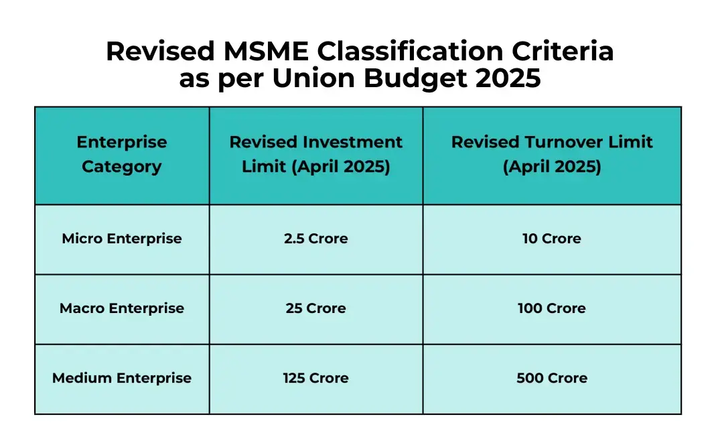
• Enhances eligibility for government liquidity schemes, priority sector lending, and cash-flow support without loss of MSME status.
• Firms can scale without prematurely exiting incentive eligibility.
Formalising for Growth: Why Udyam Registration Matters
As MSMEs prepare for expansion in 2026, formal registration under the Udyam portal is emerging as a foundational step in strengthening financial readiness. Udyam registration not only validates MSME status under the revised classification norms acts as a gateway to priority sector lending, government liquidity schemes, faster onboarding on digital trade finance platforms such as RBI-Licensed TReDS, and Samadhaan as structured recourse mechanisms.
In an environment where policy-linked financing access and digital compliance increasingly determine speed to liquidity, ensuring Udyam registration enables businesses to fully participate in formal credit ecosystems and unlock scalable working capital opportunities.
What it implies:
• Reinforces the role of digital receivable monetisation in formal credit ecosystems.
• Signals regulatory support for faster credit transmission and liquidity engineering.
Export & Trade Pressures Highlight Liquidity Risk
Recent global developments including steep tariff escalations on Indian exports and resulting government mitigation schemes have spotlighted the critical importance of working capital buffers. Exporters are seeing demand shifts and extended cash cycles amid tariff-induced uncertainity. External shocks can stretch Days Sales Outstanding (DSO), stressing cash cycles.
Tactical cash conversion strategies become operational imperatives for growth and stability.
2) Priorities to Strengthen Working Capital Resilience
A. Recompute & Compress Cash Conversion Cycle (CCC)
• Measure DSO, DPO, and Inventory Days aim for DSO <45 days, DPO >60 days, inventory <60 days.
• Set targets to reduce Cash Conversion Cycle by 15-25% within 12 months, unlocking instant liquidity per turnover.
B. Shift Receivables to TReDS Platforms
• Routinely route 70-80% of high-DSO receivables through no-recourse RBI-Licensed TReDS like KredX DTX, reducing reliance on overdrafts and collateralised credit.
• Competitive bidding cut effective working capital costs materially below traditional borrowing.
C. Operationalise TReDS Integration
• Invoice mapping: prioritise top buyers like AAA or PSUs.
• ERP automation: connect QuickBooks with TReDS APIs for near-real-time uploads.
• Buyer SLAs: standardise invoice approval within 24-48 hours.
• Bid optimisation: shorter tenor receivables often attract better pricing.
D. Dynamic Payables & Supplier Finance
• Extend DPO via reverse dynamic discounting while preserving supplier cash flows.
• Tailored early payment discounts can improve overall supply chain liquidity.
E. Segmented Collections Framework
A/B/C debtor segmentation:
A = auto-TReDS route
B = hybrid
C = prepayment or tight-credit terms.
AI-driven reminders and lock box collections enhance predictability.
F. Multi-Layer Contingency Buffers
• Maintain 5-10% operating expenditure buffers through committed TReDS funding lines.
• Exporters should layer FX hedges and tariff risk mitigants where relevant.
G. Capital Structure Rebalancing
• Prioritise lower-cost digital receivable monetisation (TReDS) over high-cost overdrafts.
• Blend priority sector lending and government subventions to optimise cost of capital.
3) TReDS Implementation Playbook
Phase 1 Internal Readiness (Week 1)
• Clean AR ledger, reconcile GST compliant invoices, and quantify TReDS receivables.
Phase 2 Platform Onboarding (Week 2)
• Evaluate TReDS partners like DTX based on lender participation, API, and settlement SLAs.
• Pilot with sample invoices for end-to-end validation.
Phase 3 Buyer Coordination (Week 3)
• Secure formal invoice acceptance SLAs with top buyers.
• Use engagement where delays occur.
Phase 4 Go Live Operations (Week 4)
• Automate post-approval invoice uploads and reconciliation workflows.
Phase 5 Performance Engine
• KPI tracking: Track funds in hand (<48 hrs), average discount rate (<8-9%), bidder count and funding success rate
4) 2026 Action Strategies For Businesses To focus
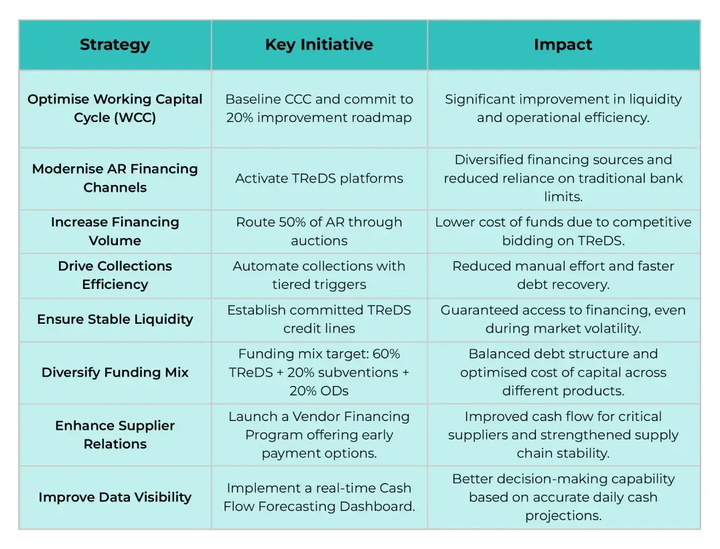
Businesses that execute this blueprint can unlock an estimated additional annual liquidity per ₹100 crore turnover and position for growth despite 2026 uncertainties.
Transform Your Working Capital and Start Onboarding on DTX by KredX Today.
Tap to Register Now