
Bridging India’s Formal Credit Gap for MSMEs Through Udyam Integration
Micro, small, and medium enterprises (MSMEs) constitute the backbone of India’s economy, contributing approximately 30% to gross domestic product (GDP) and generating employment for over 110 million individuals across diverse sectors. These enterprises drive innovation, regional development, and export competitiveness, yet they face structural challenges, including protracted payment delays averaging 90 days, limited access to affordable working capital, inadequate credit histories, and regulatory requirements that collectively impact sustainable expansion and global participation.
The Government of India (GOI), through the Ministry of Micro, Small, and Medium Enterprises (MSME), has deployed a comprehensive ecosystem of digital platforms and policy interventions to foster formalisation, enhance creditworthiness, and integrate MSMEs into institutional finance mechanisms. Central to this framework is the Trade Receivables Discounting System (TReDS) launched by the Reserve Bank of India in 2014, which operationalises digital platforms, synergising with the government’s Udyam portals to deliver tangible liquidity solutions.
Imperative of Formalisation
Formalisation represents the foundational step in transforming informal MSMEs into viable participants within India’s organised financial architecture. Without a verifiable digital identity, MSMEs remain excluded from priority sector lending targets, government procurement opportunities, and collateral-free credit guarantees. The Udyam ecosystem addresses this by providing a unified, Aadhaar-linked registration that serves as a prerequisite for over 25 central schemes, including access to TReDS platforms where sellers must possess valid Udyam or provisional IDs. Empirical evidence indicates that formalised MSMEs experience a 20-25% uplift in institutional credit disbursal, underscoring the multiplier effect on operational resilience.
Udyam Registration: The Digital Gateway to Inclusion
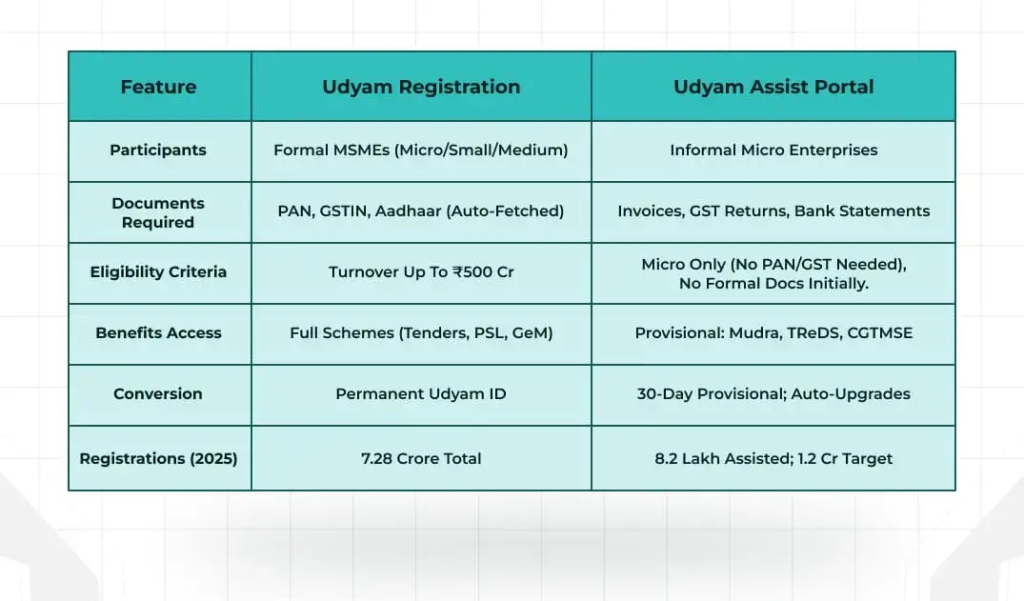
The Udyam Registration portal launched in 2020, serves as the official, government-authorised digital gateway for MSME formalisation with free, paperless, and based entirely on self-declaration. Launched to create an authentic portal to unlock seamless benefits by providing a single, eternal Udyam Registration Number (e-URN) linked seamlessly to Aadhaar, PAN, and GSTIN, perpetually valid without renewal. Registered entities benefit from instantaneous eligibility for public procurement via the Government e-Marketplace (GeM), National Small Industries Corporation (NSIC) performance guarantees, and specialised schemes like Prime Minister’s Employment Generation Programme (PMEGP). Udyam unlocks everything with Single Aadhaar-linked registration grants access to 25+ schemes, boosts lender confidence, and transforming informal enterprises into institutional finance-ready players.
Registered MSMEs gain immediate access to priority sector lending, collateral-free guarantees, GST exemptions, and government tenders through GeM. Enhanced lender confidence from verified turnover and investment data accelerates credit access and competitive financing terms.Udyam transforms informal enterprises into formal players , the essential first step for TReDS platforms, where live verification turns registration into instant working capital.
Udyam Assist Portal: Catalysing Informal Sector Transition
Complementing core Udyam, the Udyam Assist Portal, introduced in January 2024, targets India’s estimated 1.2 crore informal micro-enterprises by permitting provisional registration through alternative proofs such as invoices, GST returns, or bank statements, obviating the immediate need for PAN or GSTIN. This provisional Udyam ID confers interim access to Mudra loans, TReDS seller registration, and CGTMSE guarantees, with 65% of users upgrading to full Udyam status within 90 days.
Press Information Bureau (PIB) data for October 2025 reveals ₹18,450 crore in credit mobilised for 8.2 lakh assisted MSMEs, demonstrating the portal’s efficacy in bridging the formalisation chasm. By integrating with TReDS platforms, Udyam Assist accelerates invoice financing for invoice values up to ₹10 crore, directly addressing cash flow bottlenecks in supply chains dominated by unorganised sellers.
Comparative Analysis of Udyam vs Udyam Assist
Key GOI Initiatives Amplifying Impact
RAMP Scheme: RBI-supported Raising and Accelerating MSME Performance (RAMP) rural formalisation program mandates Udyam registration as the entry point and conducts district-level camps that streamline MSMEs into TReDS platforms. It focuses on capacity building for digital invoicing and compliance, significantly reducing informal credit dependence while accelerating liquidity access through institutional channels.
ZED Certification: The Zero Defect Zero Effect program offers up to 80% subsidy on quality certification costs exclusively for Udyam-registered MSMEs. Certified enterprises gain enhanced buyer confidence, leading to faster payments from corporates and preferential TReDS financing rates, creating a virtuous cycle of quality-driven creditworthiness.
Capacity Building Ecosystem: Comprehensive training programs through 620 MSME Development Institutes and SIDBI hubs cover Udyam registration, TReDS onboarding, digital invoicing, and regulatory compliance. These initiatives equip MSMEs with practical skills for sustained platform engagement, bridging knowledge gaps that previously hindered formal finance adoption.
TReDS Institutionalising Supply Chains
Established by the Reserve Bank of India (RBI) in March 2014 under the Payment and Settlement Systems Act, 2007, the Trade Receivables Discounting System (TReDS) authorises electronic platforms to facilitate transparent, fact-based financing of MSME receivables up to ₹10 crore per invoice. RBI mandates TReDS usage for corporates exceeding ₹500 crore turnover and all Central Public Sector Enterprises (CPSEs), ensuring institutional liquidity flows to MSME supply chains [RBI Master Direction 2024].
DTX by KredX with Official Udyam Portal Integration
DTX by KredX, India’s leading RBI-licensed TReDS platform from the original architects of the supply chain financing revolution, with direct, secure API integration to the official Udyam Portal. This makes DTX the first TReDS platform with real-time Udyam data access, enabling instant MSME verification, zero-compliance-risk onboarding, and immediate working capital deployment for India’s 7+ crore formal enterprises.
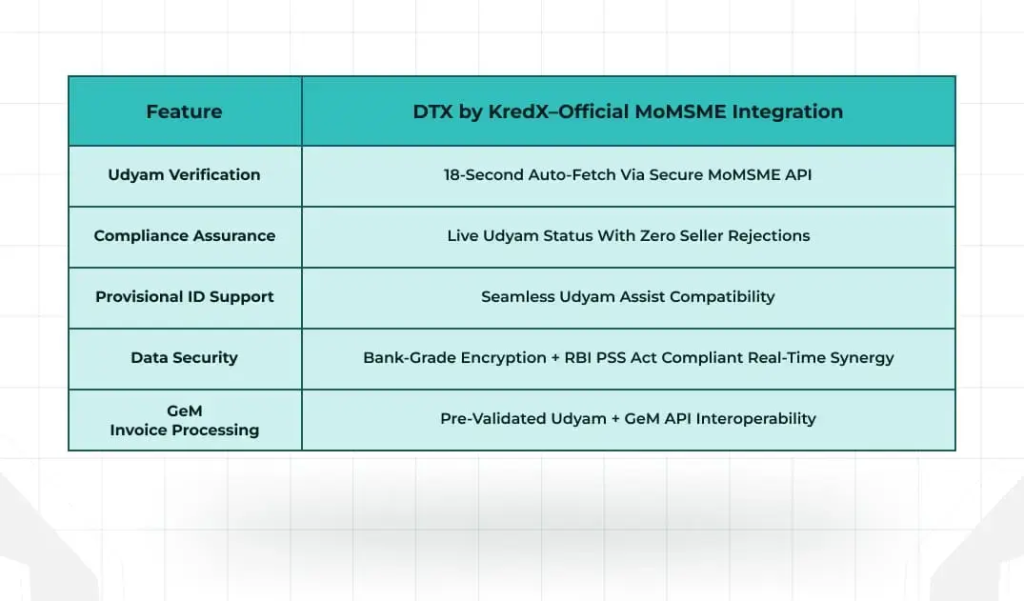
The platform facilitates through enterprise-grade, live API connectivity to the Udyam Portal and auto-fetching e-URNs in 18 seconds, supporting both full registrations and provisional Udyam Assist IDs and maintaining perpetual compliance through real-time status. The platform has already signed an exclusive MoU with the Ministry of MSME (July 2025), pioneering direct API access to the Udyam Portal for real-time verification [MoMSME Official Release].
Impact:
- Onboarding: Reduced from 7 days to 18 minutes (95% time compression)dtxindia
- Zero Compliance Risk: Real-time Udyam validation eliminates all seller disqualifications
- 50+ Financier Network: Banks and NBFCs access verified Udyam data for instant competitive bidding
- Trusted by Enterprises: Quick and cost-effective receivables financing for MSMEs powering seamless supply chain operations.
Trusted by India’s Business Ecosystem
DTX by KredX delivers comprehensive financial health tools to monitor, manage, and optimise receivables, trusted by startups, MSMEs, and large enterprises solving working capital challenges efficiently. As India’s largest supply chain finance platform, DTX RBI-licensed TReDS combines innovative technology with regulatory excellence for the most compliant and affordable supply chain financing solutions.
Get Udyam Certified → Access Instant TReDS Finance → Fuel Your GrowthUnlock full benefits on Udyam and Get Started on DTX Today.